Tuesday, April 2, 2013
Nurmikko and Donoghue join U.S. BRAIN initiative
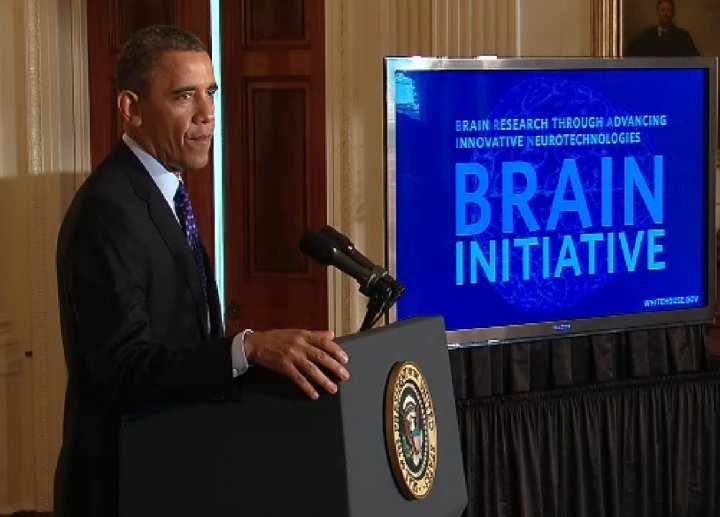
Neuroscientist John Donoghue and engineer Arto Nurmikko were on hand at the White House Tuesday morning, April 2, as President Barack Obama announced a new “Grand Challenge” initiative called BRAIN — Brain Research through Advancing Innovative Neurotechnologies. Donoghue, who directs the Brown Institute for Brain Science and is also a researcher at the Providence VA Medical Center, is part of a group
 of scientists that has helped catalyze the idea of developing the tools and techniques needed to measure and sense brain activity at the scale of the neural networks that produce thoughts, behaviors, and (when they are not working properly) disease. Scientists today can study smaller scales of dozens of neurons with electrodes or very large-scale brain activity with MRI scans, but this crucial middle scale of thousands or millions of neurons is currently out of reach. Donoghue will serve on an advisory committee to National Institutes of Health Director Francis Collins to help shape the initiative’s development.


Thursday, March 28, 2013
Shreyas Mandre wins HFSP grant
Shreyas Mandre, assistant professor of engineering, is part of an international research
team awarded a Young Investigator Grant by the Human Frontier Science Program. The
team will receive $350,000 in each of three years to study the mechanics of the human
foot.
 “Understanding the fundamental mechanics of the foot informs the fields of
biotechnology, robotics and
“Understanding the fundamental mechanics of the foot informs the fields of
biotechnology, robotics and
human evolutionary biology,” Mandre said. “Our research in this field considers the interaction of the foot with uneven ground to investigate how humans maintain a stable running gait. The interdisciplinary and international nature of this research falls squarely within HFSP purview.”
The research is led by Madhusudhan Venkadesan, a biomechanician from the National Center for Biological Sciences in India, and in collaboration with Mahesh Bandi, a physicist at Japan’s Okinawa Institute of Science and Technology. The researchers hope to shed light on evolution of bipedalism, a task possible only by combining the capabilities of the three team members.
“The goal of my lab is to develop simple but quantitatively accurate descriptions of phenomena with applications to energy, environment and biology,” Mandre said. “We welcome interdisciplinary collaboration with other groups and actively seek talented undergraduate, graduate and postdoctoral researchers.”
“The interdisciplinary and international nature of this research overlaps perfectly with the research mission of the School of Engineering and Brown University,” said Larry Larson, dean of the School of Engineering.
Based in Strasbourg, France, the Human Frontier Science Program aims to promote basic research in the life sciences by funding researchers all over the world. This year, the organization awarded $34 million to 33 research teams that include scientists from 26 countries.
“Understanding the fundamental mechanics of the foot informs the fields of
biotechnology, robotics and human evolutionary biology,” Mandre said. “Our research in this field considers the interaction of the foot with uneven ground to investigate how humans maintain a stable running gait. The interdisciplinary and international nature of this research falls squarely within HFSP purview.”
The research is led by Madhusudhan Venkadesan, a biomechanician from the National Center for Biological Sciences in India, and in collaboration with Mahesh Bandi, a physicist at Japan’s Okinawa Institute of Science and Technology. The researchers hope to shed light on evolution of bipedalism, a task possible only by combining the capabilities of the three team members.
“The goal of my lab is to develop simple but quantitatively accurate descriptions of phenomena with applications to energy, environment and biology,” Mandre said. “We welcome interdisciplinary collaboration with other groups and actively seek talented undergraduate, graduate and postdoctoral researchers.”
“The interdisciplinary and international nature of this research overlaps perfectly with the research mission of the School of Engineering and Brown University,” said Larry Larson, dean of the School of Engineering.
Based in Strasbourg, France, the Human Frontier Science Program aims to promote basic research in the life sciences by funding researchers all over the world. This year, the organization awarded $34 million to 33 research teams that include scientists from 26 countries.
Could lubricin stop OA in damaged joints?
Researchers from Brown and Rhode Island Hospital have shown that joint fluid lacking in a protein called lubricin fails to adequately lubricate joints. That lack of lubrication leads to increased friction in the joint and eventually to the death of cartilage cells. The work also shows that lubricin protects cartilage and could serve as a means to reduce the risk or even prevent osteoarthritis.
 |
|
“We’re saying it’s worth
investigating the use of lubricin
in damaged joints before onset
of osteoarthritis.”
Dr. Gregory Jay
|
Researchers from Rhode Island Hospital and Brown’s School of Engineering have shown in two different animal models that joint fluid lacking in a protein called lubricin fails to adequately lubricate joints. That lack of lubrication leads to increased friction in the joint and eventually to the death of cartilage cells, the research found. The findings, published in the Proceedings of the National Academy of Sciences, help to confirm something researchers have long thought about the root cause of osteoarthritis — that increased friction destroys cartilage, causing joints to fail. Importantly, the work also shows that lubricin protects cartilage and could serve as a means to reduce the risk or even prevent osteoarthritis.
Dr. Gregory Jay, of the Department of Emergency Medicine at Rhode Island Hospital and the School of Engineering at Brown, led the study. He talked with Kevin Stacey about the new findings.
Could you summarize what exactly the research found?
We were able to show experimentally in joints explanted from mice and cows that friction between rubbing cartilage surfaces under a physiologic load is responsible for apoptosis, or programmed cell death of the cells that make up cartilage. Importantly, we found that cell death can be mitigated by the presence of a joint protein called lubricin. Previous studies had reported that lubricin could reduce friction in joints, but none had shown that lubricin played a direct role in protecting cartilage cells.
Cartilage is a mechanical material. It’s meant to absorb strain, to be compressed, and to withstand very high loads. A typical joint can withstand 2,000 pounds per square inch easily. And yet if you overstrain it or if intervening lubricin is not present between cartilage surfaces, then the cells underneath the surface will experience excessive strain — and we show that as a result they undergo programmed cell death.
What do those findings tell us about the role of injury in osteoarthritis?
The findings suggest a mechanism by which major injury or repeated minor injuries to joints can cause osteoarthritis. We know that inflammation and injuries — meniscal tears, ACL tears, gout, inflammatory joint conditions — all down-regulate lubricin. We also know that injuries are an epidemiologic risk factor for OA. So our findings suggest that the loss of lubrication due to the down-regulation of lubricin after injury may be a causal link in the etiology of OA. Once you cause that down-regulation in lubricin, you’re creating a vulnerable period for articular cartilage, we believe.
Are there any potential clinical implications to this?
It would seem to make sense to try to restore lubricin in the period just after an injury to help protect the cartilage and possibly to lessen the prospects for developing OA later in life. Doctors currently inject hyaluronic acid — the viscous component of joint fluid — as part of a therapy called viscosupplementation. But this is generally performed in patients with advanced disease and doesn’t include lubricin. We’re saying it’s worth investigating the use of lubricin in damaged joints before onset of OA.
This study involved both medical researchers and bioengineers. How did those two perspectives inform the work?
This was a collaborative effort between the Departments of Emergency Medicine and Orthopaedics at Rhode Island Hospital and the School of Engineering at Brown.
Like many examples of translational medical research, the work is multidisciplinary and occurs where different fields intersect. Engineers were needed to develop joint pendulum measurement systems ex vivo and measures of cartilage friction in vitro. There was also innovation in testing for biological markers after mechanical testing was done.
What’s the next step for this line of research?
Similar work will be carried out in a large animal model as we work toward a possible orphan drug indication study in patients afflicted with CACP syndrome, a condition in which patients lack lubricin entirely. This will be possible once lubricin is manufactured and can be introduced into joints at risk.
Editors: Brown University has a fiber link television studio available for domestic and international live and taped interviews, and maintains an ISDN line for radio interviews. For more information, call (401) 863-2476.
Thursday, March 14, 2013
On a Mission
The bombs didn’t stop, not even on Christmas night, when they fell less than two miles away. At Mother of Mercy Hospital in the village of Gidel in Sudan’s Nuba Mountains, Christian missionary Tom Catena ’86 kept working. As the only medical doctor at the only hospital in the entire region, he had little choice.
A war over oil had broken out in 2011 between Sudan and South Sudan, and Catena found himself in the middle of it. “When the fighting started, almost all of the expatriates that were here left,” Catena says. “For me, I think the initial thought was that in good conscience I can’t leave the hospital. I was the only doctor here. I’m still the only doctor, pretty much for all of the Nuba Mountains. For me, it was fairly simple. I could not live with myself if I just packed up and left the place and left all the people here in that situation.”
During the evacuation, Catena’s nurse anesthetist left. So did his lab technician and pharmacist. “Anybody that had any training was taking off,” Catena says. “I thought, ‘Let me just stay around, and I will do my best.’” Two nuns stayed behind to help him. Meanwhile victims from the bombings streamed to the hospital.
Catena, whom other doctors have praised as a modern-day Albert Schweitzer, praised the local Nuba people, who helped to pick up the slack. Although they had little formal education, they became Catena’s nurses, assisting him as he performed surgery. He says he probably performs more than a thousand operations a year at the hospital. “People survived, much to our disbelief,” he says. “That gave us confidence, and we kept going.”
 For Catena, who lives with his staff in a concrete building near the hospital, a typical day starts at 6:30 with morning Mass. He begins rounds at 7:30. The hospital has 300 beds, but sometimes there are so many patients they must sleep two or three to a bed. On some days there is no water; on others, no electricity. “You get worn out,” he says. “You get tired. You get frustrated.”
Catena remains on call throughout the night. With no administrative staff, he also uses the evenings to order supplies and keep patient records up-to-date. Despite the fatigue and the stress, he persists. “Some days are better than others,” he says. “I enjoy the work, but some days it is drudgery. Whether terrible things happen or whether we are in danger or there is no food, the idea is we are here to serve. It is as simple as that.”
Catena’s Christian faith was apparent even at Brown, where Campus Crusade for Christ director Kent Dahlberg was a mentor and spiritual teacher. A mechanical engineering concentrator, Catena excelled academically and was a Rhodes Scholar candidate. He was also a good athlete, an Associated Press honorable mention All-American football player and a first-team All-Ivy pick as a defensive lineman. As a senior in 1985, he helped the Brown defense post shutouts in four of its seven Ivy League contests. His nickname was Catman.
“Quite simply, he’s the nicest, most unselfish person I know,” says George Reilly ’87, Catena’s teammate and fraternity brother. “In college he was my spiritual mentor, my super-tough teammate, my big brother, my comic relief. He led a Bible study in our fraternity and always led by example. He walked the walk.”
Teammate Ted Moskala ’86 recalls that Catena was small for a defensive lineman. “But he was strong, and he was extremely quick,” he adds.
Against a powerful Rhode Island team, Catena sacked Ram quarterback Tom Ehrhardt for a safety to lead Brown to a 32–27 upset win. On senior day in his final home game, he registered three sacks as Brown blanked Columbia, 34–0. “If you could combine Mother Teresa and Mean Joe Greene,” says Reilly, “you’d get Catman. He makes us all want to be better people. I tell my three daughters stories about him because he epitomized what a student-athlete is all about.” The Ivy Football Association recognized Catena for his selflessness at its annual New York City dinner on February 7.
After Brown, Catena felt called to missionary work. Realizing that in the mid-1980s opportunities for someone with his training were limited, he decided to go to medical school at Duke on a U.S. Navy scholarship. “I’ve always had an interest in other people and cultures,” he says, “and I felt called to use my abilities to serve those people.”
It was during his fourth year at Duke that he went on his first mission to Kenya. If he had any doubts about what he wanted to do with the rest of his life, they vanished in Kenya. His two months there, he says, “sort of cemented my belief. For me it was such exciting work: you got to do all kinds of different things medically. You were dealing with a population that had very little access to health care. For me this was what medicine was about.”
After graduating, he completed his navy commitment and did a postgraduate residency in Indiana. “During that time I was, of course, still interested in doing mission work,” he says, “so I was looking for organizations that would sponsor doctors, and I came across the Catholic Medical Mission Board.”
He spent a month in Guyana, which was followed by another month in Honduras. When he finished his residency in 1999, he decided to continue volunteering with the Catholic Medical Mission Board and spent two years in rural Kenya at Mutoma Hospital. He then volunteered for the next six years at St. Mary’s Hospital in Nairobi before helping establish the Mother of Mercy Hospital in southern Sudan in 2007.
The hospital’s resources were strained from the start, as victims of fighting in Darfur and, later, central and southern Sudan arrived seeking medical care. Catena twice contracted malaria in the months after the hospital opened, and he lost fifty pounds.
Catena can’t imagine leaving the country. “I’d like to stay here long term, God willing,” he says, “although I realize that this place is unstable and the situation could change any day. My plan is to stay as long as it takes to make the hospital a stable institution.”
Does he ever fear for his life? “Yes, there have been times when I thought maybe the end was coming near,” Catena says. “Despite this, I think when it’s our time to leave this earth, it’s just our time to go and not to worry about it so much. Let me do what I can while I’m still here.”
Read more about Catena and Mother of Mercy Hospital at http://cmmb.org/supporting-mother-mercy-hospital
- by Gordon Morton
(This story originally appeared in the March/April edition of the Brown Alumni Magazine.)
 |
| Tom Catena '86 |
During the evacuation, Catena’s nurse anesthetist left. So did his lab technician and pharmacist. “Anybody that had any training was taking off,” Catena says. “I thought, ‘Let me just stay around, and I will do my best.’” Two nuns stayed behind to help him. Meanwhile victims from the bombings streamed to the hospital.
Catena, whom other doctors have praised as a modern-day Albert Schweitzer, praised the local Nuba people, who helped to pick up the slack. Although they had little formal education, they became Catena’s nurses, assisting him as he performed surgery. He says he probably performs more than a thousand operations a year at the hospital. “People survived, much to our disbelief,” he says. “That gave us confidence, and we kept going.”

Catena remains on call throughout the night. With no administrative staff, he also uses the evenings to order supplies and keep patient records up-to-date. Despite the fatigue and the stress, he persists. “Some days are better than others,” he says. “I enjoy the work, but some days it is drudgery. Whether terrible things happen or whether we are in danger or there is no food, the idea is we are here to serve. It is as simple as that.”
Catena’s Christian faith was apparent even at Brown, where Campus Crusade for Christ director Kent Dahlberg was a mentor and spiritual teacher. A mechanical engineering concentrator, Catena excelled academically and was a Rhodes Scholar candidate. He was also a good athlete, an Associated Press honorable mention All-American football player and a first-team All-Ivy pick as a defensive lineman. As a senior in 1985, he helped the Brown defense post shutouts in four of its seven Ivy League contests. His nickname was Catman.
“Quite simply, he’s the nicest, most unselfish person I know,” says George Reilly ’87, Catena’s teammate and fraternity brother. “In college he was my spiritual mentor, my super-tough teammate, my big brother, my comic relief. He led a Bible study in our fraternity and always led by example. He walked the walk.”
Teammate Ted Moskala ’86 recalls that Catena was small for a defensive lineman. “But he was strong, and he was extremely quick,” he adds.
Against a powerful Rhode Island team, Catena sacked Ram quarterback Tom Ehrhardt for a safety to lead Brown to a 32–27 upset win. On senior day in his final home game, he registered three sacks as Brown blanked Columbia, 34–0. “If you could combine Mother Teresa and Mean Joe Greene,” says Reilly, “you’d get Catman. He makes us all want to be better people. I tell my three daughters stories about him because he epitomized what a student-athlete is all about.” The Ivy Football Association recognized Catena for his selflessness at its annual New York City dinner on February 7.
After Brown, Catena felt called to missionary work. Realizing that in the mid-1980s opportunities for someone with his training were limited, he decided to go to medical school at Duke on a U.S. Navy scholarship. “I’ve always had an interest in other people and cultures,” he says, “and I felt called to use my abilities to serve those people.”
It was during his fourth year at Duke that he went on his first mission to Kenya. If he had any doubts about what he wanted to do with the rest of his life, they vanished in Kenya. His two months there, he says, “sort of cemented my belief. For me it was such exciting work: you got to do all kinds of different things medically. You were dealing with a population that had very little access to health care. For me this was what medicine was about.”
After graduating, he completed his navy commitment and did a postgraduate residency in Indiana. “During that time I was, of course, still interested in doing mission work,” he says, “so I was looking for organizations that would sponsor doctors, and I came across the Catholic Medical Mission Board.”
He spent a month in Guyana, which was followed by another month in Honduras. When he finished his residency in 1999, he decided to continue volunteering with the Catholic Medical Mission Board and spent two years in rural Kenya at Mutoma Hospital. He then volunteered for the next six years at St. Mary’s Hospital in Nairobi before helping establish the Mother of Mercy Hospital in southern Sudan in 2007.
The hospital’s resources were strained from the start, as victims of fighting in Darfur and, later, central and southern Sudan arrived seeking medical care. Catena twice contracted malaria in the months after the hospital opened, and he lost fifty pounds.
Catena can’t imagine leaving the country. “I’d like to stay here long term, God willing,” he says, “although I realize that this place is unstable and the situation could change any day. My plan is to stay as long as it takes to make the hospital a stable institution.”
Does he ever fear for his life? “Yes, there have been times when I thought maybe the end was coming near,” Catena says. “Despite this, I think when it’s our time to leave this earth, it’s just our time to go and not to worry about it so much. Let me do what I can while I’m still here.”
Read more about Catena and Mother of Mercy Hospital at http://cmmb.org/supporting-mother-mercy-hospital
- by Gordon Morton
(This story originally appeared in the March/April edition of the Brown Alumni Magazine.)
Tuesday, March 12, 2013
Wei Yang to lead China’s National Natural Sciences Foundation
Wei Yang Ph.D.’85 Sc.D.’12 hon., an internationally celebrated engineer and materials science researcher, educator, and administrator, has been named president of China’s National Natural Sciences Foundation (NSFC), the nation’s top science agency. He takes the helm of an organization that last year allocated $2.8 billion to fund scientific activity. In a recent interview with Science magazine, Yang said he hopes to increase the agency’s funding substantially.
 “China has to transition from an economic powerhouse to a technological powerhouse and then to a scientific and cultural powerhouse,” he said. “To achieve this goal, we will need many scientists, and we need to convince the government that it should provide more funding to the NSFC.”
Before the NSFC, Yang was president of Zhejiang University and head of the Chinese Academy of Sciences Technological Science Division. He was the youngest person ever to achieve the rank of full professor of engineering at Tsinghua University, which he did just four years after his graduation from Brown. Born in Beijing, Yang was educated in the United States and China (B.S., Northwestern Polytechnic University, 1976; M.S., Tsinghua University, 1981; Ph.D., Brown University, 1985).
In addition to continuing an active and very productive career as a research engineer in fracture mechanics, mechatronic reliability, and micro/nanomechanics (11 books and 211 technical papers in internationally refereed journals), Yang has served in a number of national and international positions as an educator and administrator. He became director of the Failure Mechanics Laboratory of the Chinese Ministry of Education in 1993. For seven years (1997–2004), he headed the Department of Engineering Mechanics at Tsinghua, also serving for a time as executive dean of the Aerospace School. From 2004 to 2006, he served as director-general of the Academic Degrees Committee of the State Council of China and also headed the Directorate of Graduate Education. He began as president of Zhejiang University, one of China’s largest and oldest universities, in 2006.
 As head of the Chinese Academy of Sciences Technological Science Division, Yang has had extensive international scientific experience. He has served as regional editor for several journals in the field of composite materials and has been on the editorial boards of the International Journal of Fracture, Fatigue & Fracture of Engineering Materials & Structures, and the Archive of Applied Mechanics, among several others.
Early in 2009, Yang became widely known for a stern and dedicated fight against scientific misconduct, dealing strictly with researchers found to have engaged in misconduct and proactively developing training programs to support scientific integrity. Organizations and journals,Nature among them, praised his zero tolerance policies.
Yang has supported and worked for collaborations with universities in the United States, Germany, the Netherlands, Singapore and elsewhere. His own postgraduate students — more than 40 of them — have extended his international reach. More than 10 of them hold engineering faculty positions in the United States and Europe. He has been honored extensively for his efforts, including the 2009 Brown University Engineering Alumni Medal (BEAM).
 “China has to transition from an economic powerhouse to a technological powerhouse and then to a scientific and cultural powerhouse,” he said. “To achieve this goal, we will need many scientists, and we need to convince the government that it should provide more funding to the NSFC.”
Before the NSFC, Yang was president of Zhejiang University and head of the Chinese Academy of Sciences Technological Science Division. He was the youngest person ever to achieve the rank of full professor of engineering at Tsinghua University, which he did just four years after his graduation from Brown. Born in Beijing, Yang was educated in the United States and China (B.S., Northwestern Polytechnic University, 1976; M.S., Tsinghua University, 1981; Ph.D., Brown University, 1985).
In addition to continuing an active and very productive career as a research engineer in fracture mechanics, mechatronic reliability, and micro/nanomechanics (11 books and 211 technical papers in internationally refereed journals), Yang has served in a number of national and international positions as an educator and administrator. He became director of the Failure Mechanics Laboratory of the Chinese Ministry of Education in 1993. For seven years (1997–2004), he headed the Department of Engineering Mechanics at Tsinghua, also serving for a time as executive dean of the Aerospace School. From 2004 to 2006, he served as director-general of the Academic Degrees Committee of the State Council of China and also headed the Directorate of Graduate Education. He began as president of Zhejiang University, one of China’s largest and oldest universities, in 2006.

Early in 2009, Yang became widely known for a stern and dedicated fight against scientific misconduct, dealing strictly with researchers found to have engaged in misconduct and proactively developing training programs to support scientific integrity. Organizations and journals,Nature among them, praised his zero tolerance policies.
Yang has supported and worked for collaborations with universities in the United States, Germany, the Netherlands, Singapore and elsewhere. His own postgraduate students — more than 40 of them — have extended his international reach. More than 10 of them hold engineering faculty positions in the United States and Europe. He has been honored extensively for his efforts, including the 2009 Brown University Engineering Alumni Medal (BEAM).
Wednesday, March 6, 2013
New technique could improve optical devices
Understanding the source and orientation of light in light-emitting thin films — now possible with energy-momentum spectroscopy — could lead to better LEDs, solar cells, and other devices that use layered nanomaterials.
PROVIDENCE, R.I. [Brown University] — A multi-university research team has used a new spectroscopic method to gain a key insight into how light is emitted from layered nanomaterials and other thin films.
The technique, called energy-momentum spectroscopy, enables researchers to look at the light emerging from a thin film and determine whether it is coming from emitters oriented along the plane of the film or from emitters oriented perpendicular to the film. Knowing the orientations of emitters could help engineers make better use of thin-film materials in optical devices like LEDs or solar cells.
The research, published online on March 3 in Nature Nanotechnology, was a collaborative effort of Brown University, Case Western Reserve University, Columbia University, and the University of California–Santa Barbara.
The new technique takes advantage of a fundamental property of thin films: interference. Interference effects can be seen in the rainbow colors visible on the surface of soap bubbles or oil slicks. Scientists can analyze how light constructively and destructively interferes at different angles to draw conclusions about the film itself — how thick it is, for example. This new technique takes that kind of analysis one step further for light-emitting thin films.
“The key difference in our technique is we’re looking at the energy as well as the angle and polarization at which light is emitted,” said Rashid Zia, assistant professor of engineering at Brown University and one of the study’s lead authors. “We can relate these different angles to distinct orientations of emitters in the film. At some angles and polarizations, we see only the light emission from in-plane emitters, while at other angles and polarizations we see only light originating from out-of-plane emitters.”
The researchers demonstrated their technique on two important thin-film materials, molybdenum disulfide (MoS2) and PTCDA. Each represents a class of materials that shows promise for optical applications. MoS2 is a two-dimensional material similar to graphene, and PTCDA is an organic semiconductor. The research showed that light emission from MoS2 occurs only from in-plane emitters. In PTCDA, light comes from two distinct species of emitters, one in-plane and one out-of-plane.
Once the orientation of the emitters is known, Zia says, it may be possible to design structured devices that maximize those directional properties. In most applications, thin-film materials are layered on top of each other. The orientations of emitters in each layer indicate whether electronic excitations are happening within each layer or across layers, and that has implications for how such a device should be configured.
“If you were making an LED using these layered materials and you knew that the electronic excitations were happening across an interface,” Zia said, “then there’s a specific way you want to design the structure to get all of that light out and increase its overall efficiency.”
The same concept could apply to light-absorbing devices like solar cells. By understanding how the electronic excitations happen in the material, it could be possible to structure it in a way that coverts more incoming light to electricity.
“One of the exciting things about this research is how it brought together people with different expertise,” Zia said. “Our group’s expertise at Brown is in developing new forms of spectroscopy and studying the electronic origin of light emission. The Kymissis group at Columbia has a great deal of expertise in organic semiconductors, and the Shan group at Case Western has a great deal of expertise in layered nanomaterials. Jon Schuller, the study’s first author, did a great job in bringing all this expertise together. Jon was a visiting scientist here at Brown, a postdoctoral fellow in the Energy Frontier Research Center at Columbia, and is now a professor at UCSB.”
Other authors on the paper were Sinan Karaveli (Brown), Theanne Schiros (Columbia), Keliang He (Case Western), Shyuan Yang (Columbia), Ioannis Kymissis (Columbia) and Jie Shan (Case Western). Funding for the work was provided by the Air Force Office of Scientific Research, the Department of Energy, the National Science Foundation, and the Nanoelectronic Research Initiative of the Semiconductor Research Corporation.
by Kevin Stacey
PROVIDENCE, R.I. [Brown University] — A multi-university research team has used a new spectroscopic method to gain a key insight into how light is emitted from layered nanomaterials and other thin films.
 |
| The orientation of light emission The angular distribution of light emission from monolayer
MoS2, left, closely matches the theoretical calculations for
in-plane oriented emitters, right, indicating that light emission from MoS2 originates from in-plane oriented emitters. Credit: Zia lab/Brown University |
The research, published online on March 3 in Nature Nanotechnology, was a collaborative effort of Brown University, Case Western Reserve University, Columbia University, and the University of California–Santa Barbara.
The new technique takes advantage of a fundamental property of thin films: interference. Interference effects can be seen in the rainbow colors visible on the surface of soap bubbles or oil slicks. Scientists can analyze how light constructively and destructively interferes at different angles to draw conclusions about the film itself — how thick it is, for example. This new technique takes that kind of analysis one step further for light-emitting thin films.
“The key difference in our technique is we’re looking at the energy as well as the angle and polarization at which light is emitted,” said Rashid Zia, assistant professor of engineering at Brown University and one of the study’s lead authors. “We can relate these different angles to distinct orientations of emitters in the film. At some angles and polarizations, we see only the light emission from in-plane emitters, while at other angles and polarizations we see only light originating from out-of-plane emitters.”
The researchers demonstrated their technique on two important thin-film materials, molybdenum disulfide (MoS2) and PTCDA. Each represents a class of materials that shows promise for optical applications. MoS2 is a two-dimensional material similar to graphene, and PTCDA is an organic semiconductor. The research showed that light emission from MoS2 occurs only from in-plane emitters. In PTCDA, light comes from two distinct species of emitters, one in-plane and one out-of-plane.
 |
| Rashid Zia "If you were making an LED using these layered materials and you knew that the electronic excitations were happening across an interface, then there's a specific way you want to design the structure to get all of that light out and increase its overall efficiency." |
“If you were making an LED using these layered materials and you knew that the electronic excitations were happening across an interface,” Zia said, “then there’s a specific way you want to design the structure to get all of that light out and increase its overall efficiency.”
The same concept could apply to light-absorbing devices like solar cells. By understanding how the electronic excitations happen in the material, it could be possible to structure it in a way that coverts more incoming light to electricity.
“One of the exciting things about this research is how it brought together people with different expertise,” Zia said. “Our group’s expertise at Brown is in developing new forms of spectroscopy and studying the electronic origin of light emission. The Kymissis group at Columbia has a great deal of expertise in organic semiconductors, and the Shan group at Case Western has a great deal of expertise in layered nanomaterials. Jon Schuller, the study’s first author, did a great job in bringing all this expertise together. Jon was a visiting scientist here at Brown, a postdoctoral fellow in the Energy Frontier Research Center at Columbia, and is now a professor at UCSB.”
Other authors on the paper were Sinan Karaveli (Brown), Theanne Schiros (Columbia), Keliang He (Case Western), Shyuan Yang (Columbia), Ioannis Kymissis (Columbia) and Jie Shan (Case Western). Funding for the work was provided by the Air Force Office of Scientific Research, the Department of Energy, the National Science Foundation, and the Nanoelectronic Research Initiative of the Semiconductor Research Corporation.
by Kevin Stacey
Thursday, February 28, 2013
Brown unveils novel wireless brain sensor
In a significant advance for brain-machine interfaces, engineers at Brown University have developed a novel wireless, broadband, rechargeable, fully implantable brain sensor that has performed well in animal models for more than a year. They describe the result in the Journal of Neural Engineering and at a conference this week.
PROVIDENCE, R.I. [Brown University] — A team of neuroengineers based at Brown University has developed a fully implantable and rechargeable wireless brain sensor capable of relaying real-time broadband signals from up to 100 neurons in freely moving subjects. Several copies of the novel low-power device, described in the Journal of Neural Engineering, have been performing well in animal models for more than year, a first in the brain-computer interface field. Brain-computer interfaces could help people with severe paralysis control devices with their thoughts.
Arto Nurmikko, professor of engineering at Brown University who oversaw the device’s invention, is presenting it this week at the 2013 International Workshop on Clinical Brain-Machine Interface Systems in Houston.
“This has features that are somewhat akin to a cell phone, except the conversation that is being sent out is the brain talking wirelessly,” Nurmikko said.
Neuroscientists can use such a device to observe, record, and analyze the signals emitted by scores of neurons in particular parts of the animal model’s brain.
Meanwhile, wired systems using similar implantable sensing electrodes are being investigated in brain-computer interface research to assess the feasibility of people with severe paralysis moving assistive devices like robotic arms or computer cursors by thinking about moving their arms and hands.
This wireless system addresses a major need for the next step in providing a practical brain-computer interface,” said neuroscientist John Donoghue, the Wriston Professor of Neuroscience at Brown University and director of the Brown Institute for Brain Science.
Tightly packed technology
In the device, a pill-sized chip of electrodes implanted on the cortex sends signals through uniquely designed electrical connections into the device’s laser-welded, hermetically sealed titanium “can.” The can measures 2.2 inches (56 mm) long, 1.65 inches (42 mm) wide, and 0.35 inches (9 mm) thick. That small volume houses an entire signal processing system: a lithium ion battery, ultralow-power integrated circuits designed at Brown for signal processing and conversion, wireless radio and infrared transmitters, and a copper coil for recharging — a “brain radio.” All the wireless and charging signals pass through an electromagnetically transparent sapphire window.
In all, the device looks like a miniature sardine can with a porthole.
But what the team has packed inside makes it a major advance among brain-machine interfaces, said lead author David Borton, a former Brown graduate student and postdoctoral research associate who is now at Ecole Polytechnique Federale Lausanne in Switzerland.
“What makes the achievement discussed in this paper unique is how it integrated many individual innovations into a complete system with potential for neuroscientific gain greater than the sum of its parts,” Borton said. “Most importantly, we show the first fully implanted microsystem operated wirelessly for more than 12 months in large animal models — a milestone for potential [human] clinical translation.”
The device transmits data at 24 Mbps via 3.2 and 3.8 Ghz microwave frequencies to an external receiver. After a two-hour charge, delivered wirelessly through the scalp via induction, it can operate for more than six hours.
“The device uses less than 100 milliwatts of power, a key figure of merit,” Nurmikko said.
Co-author Ming Yin, a Brown postdoctoral scholar and electrical engineer, said one of the major challenges that the team overcame in building the device was optimizing its performance given the requirements that the implant device be small, low-power and leak-proof, potentially for decades.
“We tried to make the best tradeoff between the critical specifications of the device, such as power consumption, noise performance, wireless bandwidth and operational range,” Yin said. “Another major challenge we encountered was to integrate and assemble all the electronics of the device into a miniaturized package that provides long-term hermeticity (water-proofing) and biocompatibility as well as transparency to the wireless data, power, and on-off switch signals.”
With early contributions by electrical engineer William Patterson at Brown, Yin helped to design the custom chips for converting neural signals into digital data. The conversion has to be done within the device, because brain signals are not produced in the ones and zeros of computer data.
Ample applications
The team worked closely with neurosurgeons to implant the device in three pigs and three rhesus macaque monkeys. The research in these six animals has been helping scientists better observe complex neural signals for as long as 16 months so far. In the new paper, the team shows some of the rich neural signals they have been able to record in the lab. Ultimately this could translate to significant advances that can also inform human neuroscience.
Current wired systems constrain the actions of research subjects, Nurmikko said. The value of wireless transmission is that it frees subjects to move however they intend, allowing them to produce a wider variety of more realistic behaviors. If neuroscientists want to observe the brain signals produced during some running or foraging behaviors, for instance, they can’t use a cabled sensor to study how neural circuits would form those plans for action and execution or strategize in decision making.
In the experiments in the new paper, the device is connected to one array of 100 cortical electrodes, the microscale individual neural listening posts, but the new device design allows for multiple arrays to be connected, Nurmikko said. That would allow scientists to observe ensembles of neurons in multiple related areas of a brain network.
The new wireless device is not approved for use in humans and is not used in clinical trials of brain-computer interfaces. It was designed, however, with that translational motivation.
“This was conceived very much in concert with the larger BrainGate* team, including neurosurgeons and neurologists giving us advice as to what were appropriate strategies for eventual clinical applications,” said Nurmikko, who is also affiliated with the Brown Institute for Brain Science.
Borton is now spearheading the development of a collaboration between EPFL and Brown to use a version of the device to study the role of the motor cortex in an animal model of Parkinson’s disease.
Meanwhile the Brown team is continuing work on advancing the device for even larger amounts of neural data transmission, reducing its size even further, and improving other aspects of the device’s safety and reliability so that it can someday be considered for clinical application in people with movement disabilities.
In addition to Nurmikko, Borton and Yin, the paper was also co-authored by Juan Aceros, an expert in mechanical engineering.
The National Institutes of Health/National Institute of Biomedical Imaging and Bioengineering and National Institute of Neurological Disorders and Stroke (Grant 1R01EB007401-01), with partial support from the National Science Foundation (Grants: 0937848) and the Defense Advanced Research Projects Agency (Contract: N66001-10-C-2010), funded the research.
*Caution: Investigational device. Limited by federal law to investigational use.
by David Orenstein
PROVIDENCE, R.I. [Brown University] — A team of neuroengineers based at Brown University has developed a fully implantable and rechargeable wireless brain sensor capable of relaying real-time broadband signals from up to 100 neurons in freely moving subjects. Several copies of the novel low-power device, described in the Journal of Neural Engineering, have been performing well in animal models for more than year, a first in the brain-computer interface field. Brain-computer interfaces could help people with severe paralysis control devices with their thoughts.
 |
| Cortex communication Engineers Arto Nurmikko and Ming Yin examine their prototype wireless, broadband neural sensing device. Credit: Fred Field for Brown University |
“This has features that are somewhat akin to a cell phone, except the conversation that is being sent out is the brain talking wirelessly,” Nurmikko said.
Neuroscientists can use such a device to observe, record, and analyze the signals emitted by scores of neurons in particular parts of the animal model’s brain.
Meanwhile, wired systems using similar implantable sensing electrodes are being investigated in brain-computer interface research to assess the feasibility of people with severe paralysis moving assistive devices like robotic arms or computer cursors by thinking about moving their arms and hands.
This wireless system addresses a major need for the next step in providing a practical brain-computer interface,” said neuroscientist John Donoghue, the Wriston Professor of Neuroscience at Brown University and director of the Brown Institute for Brain Science.
Tightly packed technology
 | |
| David Borton "The first fully implanted microsystem operated wirelessly for more than 12 months in large animal models - a milestone." |
In all, the device looks like a miniature sardine can with a porthole.
But what the team has packed inside makes it a major advance among brain-machine interfaces, said lead author David Borton, a former Brown graduate student and postdoctoral research associate who is now at Ecole Polytechnique Federale Lausanne in Switzerland.
“What makes the achievement discussed in this paper unique is how it integrated many individual innovations into a complete system with potential for neuroscientific gain greater than the sum of its parts,” Borton said. “Most importantly, we show the first fully implanted microsystem operated wirelessly for more than 12 months in large animal models — a milestone for potential [human] clinical translation.”
The device transmits data at 24 Mbps via 3.2 and 3.8 Ghz microwave frequencies to an external receiver. After a two-hour charge, delivered wirelessly through the scalp via induction, it can operate for more than six hours.
“The device uses less than 100 milliwatts of power, a key figure of merit,” Nurmikko said.
Co-author Ming Yin, a Brown postdoctoral scholar and electrical engineer, said one of the major challenges that the team overcame in building the device was optimizing its performance given the requirements that the implant device be small, low-power and leak-proof, potentially for decades.
“We tried to make the best tradeoff between the critical specifications of the device, such as power consumption, noise performance, wireless bandwidth and operational range,” Yin said. “Another major challenge we encountered was to integrate and assemble all the electronics of the device into a miniaturized package that provides long-term hermeticity (water-proofing) and biocompatibility as well as transparency to the wireless data, power, and on-off switch signals.”
With early contributions by electrical engineer William Patterson at Brown, Yin helped to design the custom chips for converting neural signals into digital data. The conversion has to be done within the device, because brain signals are not produced in the ones and zeros of computer data.
Ample applications
The team worked closely with neurosurgeons to implant the device in three pigs and three rhesus macaque monkeys. The research in these six animals has been helping scientists better observe complex neural signals for as long as 16 months so far. In the new paper, the team shows some of the rich neural signals they have been able to record in the lab. Ultimately this could translate to significant advances that can also inform human neuroscience.
Current wired systems constrain the actions of research subjects, Nurmikko said. The value of wireless transmission is that it frees subjects to move however they intend, allowing them to produce a wider variety of more realistic behaviors. If neuroscientists want to observe the brain signals produced during some running or foraging behaviors, for instance, they can’t use a cabled sensor to study how neural circuits would form those plans for action and execution or strategize in decision making.
In the experiments in the new paper, the device is connected to one array of 100 cortical electrodes, the microscale individual neural listening posts, but the new device design allows for multiple arrays to be connected, Nurmikko said. That would allow scientists to observe ensembles of neurons in multiple related areas of a brain network.
The new wireless device is not approved for use in humans and is not used in clinical trials of brain-computer interfaces. It was designed, however, with that translational motivation.
“This was conceived very much in concert with the larger BrainGate* team, including neurosurgeons and neurologists giving us advice as to what were appropriate strategies for eventual clinical applications,” said Nurmikko, who is also affiliated with the Brown Institute for Brain Science.
Borton is now spearheading the development of a collaboration between EPFL and Brown to use a version of the device to study the role of the motor cortex in an animal model of Parkinson’s disease.
Meanwhile the Brown team is continuing work on advancing the device for even larger amounts of neural data transmission, reducing its size even further, and improving other aspects of the device’s safety and reliability so that it can someday be considered for clinical application in people with movement disabilities.
In addition to Nurmikko, Borton and Yin, the paper was also co-authored by Juan Aceros, an expert in mechanical engineering.
The National Institutes of Health/National Institute of Biomedical Imaging and Bioengineering and National Institute of Neurological Disorders and Stroke (Grant 1R01EB007401-01), with partial support from the National Science Foundation (Grants: 0937848) and the Defense Advanced Research Projects Agency (Contract: N66001-10-C-2010), funded the research.
*Caution: Investigational device. Limited by federal law to investigational use.
by David Orenstein
Friday, February 22, 2013
Brown researchers build robotic bat wing
The strong, flapping flight of bats offers great possibilities for the design of small aircraft, among other applications. By building a robotic bat wing, Brown researchers have uncovered flight secrets of real bats: the function of ligaments, the elasticity of skin, the structural support of musculature, skeletal flexibility, upstroke, downstroke.
PROVIDENCE, R.I. [Brown University] — Researchers at Brown University have developed a robotic bat wing that is providing valuable new information about dynamics of flapping flight in real bats.
The robot, which mimics the wing shape and motion of the lesser dog-faced fruit bat, is designed to flap while attached to a force transducer in a wind tunnel. As the lifelike wing flaps, the force transducer records the aerodynamic forces generated by the moving wing. By measuring the power output of the three servo motors that control the robot’s seven movable joints, researchers can evaluate the energy required to execute wing movements.
Testing showed the robot can match the basic flight parameters of bats, producing enough thrust to overcome drag and enough lift to carry the weight of the model species.
A paper describing the robot and presenting results from preliminary experiments is published in the journal Bioinspiration and Biomimetics. The work was done in labs of Brown professors Kenneth Breuer and Sharon Swartz, who are the senior authors on the paper. Breuer, an engineer, and Swartz, a biologist, have studied bat flight and anatomy for years.
The faux flapper generates data that could never be collected directly from live animals, said Joseph Bahlman, a graduate student at Brown who led the project. Bats can’t fly when connected to instruments that record aerodynamic forces directly, so that isn’t an option — and bats don’t take requests.
Brown U. researchers build a "robatic" bat wing from Brown University on Vimeo.
“We can’t ask a bat to flap at a frequency of eight hertz then raise it to nine hertz so we can see what difference that makes,” Bahlman said. “They don’t really cooperate that way.”
But the model does exactly what the researchers want it to do. They can control each of its movement capabilities — kinematic parameters — individually. That way they can adjust one parameter while keeping the rest constant to isolate the effects.
“We can answer questions like, ‘Does increasing wing beat frequency improve lift and what’s the energetic cost of doing that?’” Bahlman said. “We can directly measure the relationship between these kinematic parameters, aerodynamic forces, and energetics.”
Detailed experimental results from the robot will be described in future research papers, but this first paper includes some preliminary results from a few case studies.
One experiment looked at the aerodynamic effects of wing folding. Bats and some birds fold their wings back during the upstroke. Previous research from Brown had found that folding helped the bats save energy, but how folding affected aerodynamic forces wasn’t clear. Testing with the robot wing shows that folding is all about lift.
In a flapping animal, positive lift is generated by the downstroke, but some of that lift is undone by the subsequent upstroke, which generates negative lift. By running trials with and without wing folding, the robot showed that folding the wing on the upstroke dramatically decreases that negative lift, increasing net lift by 50 percent.
Data like that will not only give new insights into the mechanics of bat flight, it could aid the design of small flapping aircraft. The research was funded by the U.S. Air Force Office of Scientific Research and the National Science Foundation..
Inspired by the real thing
Bat wings are complex things. They span most of the length of a bat’s body, from shoulder to foot. They are supported and moved by two arm bones and five finger-like digits. Over those bones is a super-elastic skin that can stretch up to 400 percent without tearing. The eight-inch robot mimics that anatomy with plastic bones carefully fabricated on a 3-D printer to match proportions of a real bat. The skin is made of a silicone elastomer. The joints are actuated by servo motors that pull on tendon-like cables, which in turn pull on the joints.
The robot doesn’t quite match the complexity of a real bat’s wing, which has 25 joints and 34 degrees of freedom. An exact simulation isn’t feasible given today’s technology and wouldn’t be desirable anyway, Bahlman said. Part of why the model is useful is that it distills bat flapping down to five fundamental parameters: flapping frequency, flapping amplitude, the angle of the flap relative to the ground, the amount of time used for the downstroke, and the extent to which the wings can fold back.
Experimental data aside, Bahlman said there were many lessons learned just in building the robot and getting it to work properly. “We learned a lot about how bats work from trying to duplicate them and having things go wrong,” he said.
During testing, for example, the tongue and groove joint used for the robot’s elbow broke repeatedly. The forces on the wing would spread open the groove, and eventually break it open. Bahlman eventually wrapped steel cable around the joint to keep it intact, similar to the way ligaments hold joints together in real animals.
The fact that the elbow was a characteristic weak point in the robot might help to explain the musculature of elbows in real bats. Bats have a large set of muscles at the elbow that are not positioned to flex the joint. In humans, these muscles are used in the motion that helps us turn our palms up or down. Bats can’t make that motion, however, so the fact that these muscles are so large was something of a mystery. Bahlman’s experience with the robot suggests these muscles may be adapted to resist bending in a direction that would break the joint open.
The wing membrane provided more lessons. It often tore at the leading edge, prompting Bahlman to reinforce that spot with elastic threads. The fix ended up looking a lot like the tendon and muscle that reinforce leading edges in bats, underscoring how important those structures are.
Now that the model is operational, Bahlman has lots of plans for it.
“The next step is to start playing with the materials,” he said. “We’d like to try different wing materials, different amounts of flexibility on the bones, looking to see if there are beneficial tradeoffs in these material properties.”
- by Kevin Stacey
PROVIDENCE, R.I. [Brown University] — Researchers at Brown University have developed a robotic bat wing that is providing valuable new information about dynamics of flapping flight in real bats.
The robot, which mimics the wing shape and motion of the lesser dog-faced fruit bat, is designed to flap while attached to a force transducer in a wind tunnel. As the lifelike wing flaps, the force transducer records the aerodynamic forces generated by the moving wing. By measuring the power output of the three servo motors that control the robot’s seven movable joints, researchers can evaluate the energy required to execute wing movements.
 |
| Wing of bat in life and lab A robotic bat wing lets researchers measure forces, joint movements, and flight parameters - and learn more about how the real thing operates in nature. Credit: Breuer and Swartz Labs/Brown University |
A paper describing the robot and presenting results from preliminary experiments is published in the journal Bioinspiration and Biomimetics. The work was done in labs of Brown professors Kenneth Breuer and Sharon Swartz, who are the senior authors on the paper. Breuer, an engineer, and Swartz, a biologist, have studied bat flight and anatomy for years.
The faux flapper generates data that could never be collected directly from live animals, said Joseph Bahlman, a graduate student at Brown who led the project. Bats can’t fly when connected to instruments that record aerodynamic forces directly, so that isn’t an option — and bats don’t take requests.
Brown U. researchers build a "robatic" bat wing from Brown University on Vimeo.
“We can’t ask a bat to flap at a frequency of eight hertz then raise it to nine hertz so we can see what difference that makes,” Bahlman said. “They don’t really cooperate that way.”
But the model does exactly what the researchers want it to do. They can control each of its movement capabilities — kinematic parameters — individually. That way they can adjust one parameter while keeping the rest constant to isolate the effects.
“We can answer questions like, ‘Does increasing wing beat frequency improve lift and what’s the energetic cost of doing that?’” Bahlman said. “We can directly measure the relationship between these kinematic parameters, aerodynamic forces, and energetics.”
Detailed experimental results from the robot will be described in future research papers, but this first paper includes some preliminary results from a few case studies.
One experiment looked at the aerodynamic effects of wing folding. Bats and some birds fold their wings back during the upstroke. Previous research from Brown had found that folding helped the bats save energy, but how folding affected aerodynamic forces wasn’t clear. Testing with the robot wing shows that folding is all about lift.
 |
| Studying an animal with unique abilities Over the years, Kenneth Breuer, an engineer, and Sharon Swartz, a biologist, have developed a large archive of bat data, from wind tunnels to field studies and slow-motion video. |
Data like that will not only give new insights into the mechanics of bat flight, it could aid the design of small flapping aircraft. The research was funded by the U.S. Air Force Office of Scientific Research and the National Science Foundation..
Inspired by the real thing
Bat wings are complex things. They span most of the length of a bat’s body, from shoulder to foot. They are supported and moved by two arm bones and five finger-like digits. Over those bones is a super-elastic skin that can stretch up to 400 percent without tearing. The eight-inch robot mimics that anatomy with plastic bones carefully fabricated on a 3-D printer to match proportions of a real bat. The skin is made of a silicone elastomer. The joints are actuated by servo motors that pull on tendon-like cables, which in turn pull on the joints.
The robot doesn’t quite match the complexity of a real bat’s wing, which has 25 joints and 34 degrees of freedom. An exact simulation isn’t feasible given today’s technology and wouldn’t be desirable anyway, Bahlman said. Part of why the model is useful is that it distills bat flapping down to five fundamental parameters: flapping frequency, flapping amplitude, the angle of the flap relative to the ground, the amount of time used for the downstroke, and the extent to which the wings can fold back.
Experimental data aside, Bahlman said there were many lessons learned just in building the robot and getting it to work properly. “We learned a lot about how bats work from trying to duplicate them and having things go wrong,” he said.
During testing, for example, the tongue and groove joint used for the robot’s elbow broke repeatedly. The forces on the wing would spread open the groove, and eventually break it open. Bahlman eventually wrapped steel cable around the joint to keep it intact, similar to the way ligaments hold joints together in real animals.
The fact that the elbow was a characteristic weak point in the robot might help to explain the musculature of elbows in real bats. Bats have a large set of muscles at the elbow that are not positioned to flex the joint. In humans, these muscles are used in the motion that helps us turn our palms up or down. Bats can’t make that motion, however, so the fact that these muscles are so large was something of a mystery. Bahlman’s experience with the robot suggests these muscles may be adapted to resist bending in a direction that would break the joint open.
The wing membrane provided more lessons. It often tore at the leading edge, prompting Bahlman to reinforce that spot with elastic threads. The fix ended up looking a lot like the tendon and muscle that reinforce leading edges in bats, underscoring how important those structures are.
Now that the model is operational, Bahlman has lots of plans for it.
“The next step is to start playing with the materials,” he said. “We’d like to try different wing materials, different amounts of flexibility on the bones, looking to see if there are beneficial tradeoffs in these material properties.”
- by Kevin Stacey
Thursday, February 14, 2013
Brown Engineering Alumni H. David Hibbitt Ph.D. ’72 and Enrique Lavernia ’82 Elected to the National Academy of Engineering
Brown University engineering alumni H. David Hibbitt Ph.D. ’72 and Enrique Lavernia ’82 have been elected to the National Academy of Engineering (NAE). Hibbitt, founder and retired chairman of ABAQUS Inc. (now known as Dassault Systèmes Simulia Corp.), was honored for creation and development of the ABAQUS finite element code for nonlinear structural analysis and its worldwide dissemination. He is one of 11 new foreign associates elected.
 “I have been truly fortunate in having so many talented colleagues who chose to join our efforts, so I view this award as coming to me as the representative of that team,” said Hibbitt. “It is a great honor for us all. It is the outcome of work by an amazingly strong team of applied mechanics people, mathematicians, and computer scientists, all working together to deliver the Abaqus software suite. Several others in that team also came from Brown Engineering, including Paul Sorensen ’71 Sc.M.’75 Ph.D.’77, Joop Nagtegaal Ph.D. ’73, David Berman ’84 Sc.M.’85, Mark Bohm ’84, and David Reynolds Sc.M.’91 Ph.D.’93.”
Lavernia, Dean of the College of Engineering, and Distinguished Professor of Chemical Engineering and Materials Science at University of California, Davis, was recognized for contributions to novel processing of metals and alloys, and for leadership in engineering education. He is one of 69 new members elected. The total U.S. membership is now 2,250 members and the number of foreign associates is now 211.
“This is a spectacular achievement for David and Enrique and we are extremely happy for them,” said Dean Larry Larson. “To have two alumni elected in one year from Brown is a wonderful accomplishment.”
Maurice Herlihy, professor of computer science at Brown, was also elected to the NAE this year for concurrent computing techniques for linearizability, non-blocking data structures, and transactional memory.
Michael Ortiz, who was a professor at Brown from 1984-1995 and is now a professor at California Institute of Technology, was elected for contributions to computational mechanics to advance the underpinnings of solid mechanics.
Election to the National Academy of Engineering is among the highest professional distinctions accorded to an engineer. Academy membership honors those who have made outstanding contributions to “engineering research, practice, or education, including, where appropriate, significant contributions to the engineering literature,” and to the “pioneering of new and developing fields of technology, making major advancements in traditional fields of engineering, or developing/implementing innovative approaches to engineering education.”
Hibbitt and Lavernia join an exclusive group of 12 Brown engineering alumni already in the NAE that includes: Walter J. Weber ’56 (elected 1985), William F. Allen ’41 (elected 1986), T. Dixon Dudderar PhD’66 (elected 1992), Wai-Fah Chen PhD’66 (elected 1995), George J. Dvorak (elected 1995), Marc S. Newkirk ’69 (elected 1997), Hratch Gregory Semerjian Sc.M.’68 Ph.D.’72 (elected 2000), Chain T. Liu Sc.M.’64 Ph.D.’67 (elected 2004), Robert M. McMeeking PhD’75 (elected 2005), Jean-Yves Parlange Ph.D.’62 (elected 2006), Alan I. Taub ’76 (elected 2006), and Ares J. Rosakis ScM’80 PhD’83 (elected 2011).
Ten current or former Brown engineering faculty members have been elected to the National Academy of Engineering, including Huajian Gao, Walter H. Annenberg Professor of Engineering, who was elected in 2012. Other members include: Vice President for Research and Otis Randall University Professor Clyde Briant (elected 2010), Subra Suresh (elected 2002), Professor Emeritus Alan Needleman (elected 2000), Professor Emeritus L.B. Freund (elected 1994), Rush C. Hawkins University Professor Rod Clifton (elected 1989), Joseph Kestin (elected 1982), James R. Rice (elected 1980), Daniel C. Drucker (elected 1967), and William Prager (elected 1965).
“I have been truly fortunate in having so many talented colleagues who chose to join our efforts, so I view this award as coming to me as the representative of that team,” said Hibbitt. “It is a great honor for us all. It is the outcome of work by an amazingly strong team of applied mechanics people, mathematicians, and computer scientists, all working together to deliver the Abaqus software suite. Several others in that team also came from Brown Engineering, including Paul Sorensen ’71 Sc.M.’75 Ph.D.’77, Joop Nagtegaal Ph.D. ’73, David Berman ’84 Sc.M.’85, Mark Bohm ’84, and David Reynolds Sc.M.’91 Ph.D.’93.”
Lavernia, Dean of the College of Engineering, and Distinguished Professor of Chemical Engineering and Materials Science at University of California, Davis, was recognized for contributions to novel processing of metals and alloys, and for leadership in engineering education. He is one of 69 new members elected. The total U.S. membership is now 2,250 members and the number of foreign associates is now 211.
“This is a spectacular achievement for David and Enrique and we are extremely happy for them,” said Dean Larry Larson. “To have two alumni elected in one year from Brown is a wonderful accomplishment.”
Maurice Herlihy, professor of computer science at Brown, was also elected to the NAE this year for concurrent computing techniques for linearizability, non-blocking data structures, and transactional memory.
Michael Ortiz, who was a professor at Brown from 1984-1995 and is now a professor at California Institute of Technology, was elected for contributions to computational mechanics to advance the underpinnings of solid mechanics.
Election to the National Academy of Engineering is among the highest professional distinctions accorded to an engineer. Academy membership honors those who have made outstanding contributions to “engineering research, practice, or education, including, where appropriate, significant contributions to the engineering literature,” and to the “pioneering of new and developing fields of technology, making major advancements in traditional fields of engineering, or developing/implementing innovative approaches to engineering education.”
Hibbitt and Lavernia join an exclusive group of 12 Brown engineering alumni already in the NAE that includes: Walter J. Weber ’56 (elected 1985), William F. Allen ’41 (elected 1986), T. Dixon Dudderar PhD’66 (elected 1992), Wai-Fah Chen PhD’66 (elected 1995), George J. Dvorak (elected 1995), Marc S. Newkirk ’69 (elected 1997), Hratch Gregory Semerjian Sc.M.’68 Ph.D.’72 (elected 2000), Chain T. Liu Sc.M.’64 Ph.D.’67 (elected 2004), Robert M. McMeeking PhD’75 (elected 2005), Jean-Yves Parlange Ph.D.’62 (elected 2006), Alan I. Taub ’76 (elected 2006), and Ares J. Rosakis ScM’80 PhD’83 (elected 2011).
Ten current or former Brown engineering faculty members have been elected to the National Academy of Engineering, including Huajian Gao, Walter H. Annenberg Professor of Engineering, who was elected in 2012. Other members include: Vice President for Research and Otis Randall University Professor Clyde Briant (elected 2010), Subra Suresh (elected 2002), Professor Emeritus Alan Needleman (elected 2000), Professor Emeritus L.B. Freund (elected 1994), Rush C. Hawkins University Professor Rod Clifton (elected 1989), Joseph Kestin (elected 1982), James R. Rice (elected 1980), Daniel C. Drucker (elected 1967), and William Prager (elected 1965).
Monday, February 11, 2013
Robert Rome Named Associate Dean for Development and Planning at Brown University School of Engineering
Robert Rome has been named to the newly created position of associate dean for development and planning at the School of Engineering at Brown University. Rome began his duties on February 4 and is responsible for development of expanded master’s programs, growth of industry connections, planning for space growth of the School, communications, development, and diversity initiatives.
 Rome comes to College Hill from the University of California San Diego, where he was the chief operations officer of the Department of Electrical and Computer Engineering. He brings a wealth of experience in development, student affairs, graduate program development, and financial management.
Rome holds a bachelor’s degree in psychology from American University and a master’s degree in education from the University of Pennsylvania.
 Rome comes to College Hill from the University of California San Diego, where he was the chief operations officer of the Department of Electrical and Computer Engineering. He brings a wealth of experience in development, student affairs, graduate program development, and financial management.
Rome holds a bachelor’s degree in psychology from American University and a master’s degree in education from the University of Pennsylvania.
Tuesday, January 29, 2013
A better way to culture central nervous cells
A protein associated with neuron damage in Alzheimer's patients provides a superior scaffold for growing central nervous system cells in the lab. The findings could have clinical implications for producing neural implants and offers new insights on the complex link between the apoE4 apolipoprotein and Alzheimer's disease. Results appear in the journal Biomaterials.
PROVIDENCE, R.I. [Brown University] — A protein associated with neuron damage in people with Alzheimer’s disease is surprisingly useful in promoting neuron growth in the lab, according to a new study by engineering researchers at Brown University. The findings, in press at the journal Biomaterials, suggest a better method of growing neurons outside the body that might then be implanted to treat people with neurodegenerative diseases.
The research compared the effects of two proteins that can be used as an artificial scaffold for growing neurons (nerve cells) from the central nervous system. The study found that central nervous system neurons from rats cultured in apolipoprotein E-4 (apoE4) grew better than neurons cultured in laminin, which had been considered the gold standard for growing mammalian neurons in the lab.
“Most scientists assumed that laminin was the best protein for growing CNS (central nervous system),” said Kwang-Min Kim, a biomedical engineering graduate student at Brown University and lead author of the study, “but we demonstrated that apoE4 has substantially better performance for mammalian CNS neurons.”
Kim performed the research under the direction of Tayhas Palmore, professor of engineering and medical science and Kim’s Ph.D. adviser. Also involved in the project was Janice Vicenty, an undergraduate from the University of Puerto Rico, who was working in the Palmore lab as a summer research fellow through the Leadership Alliance.
The results are surprising partly because of the association of apoE4 with Alzheimer’s. Apolipoproteins are responsible for distributing and depositing cholesterols and other lipids in the brain. They come in three varieties: apoE2, apoE3 and apoE4. People with the gene that produces apoE4 are at higher risk for amyloid plaques and neurofibrillary tangles, the hallmarks of Alzheimer’s. But exactly how the protein itself contributes to Alzheimer’s is not known.
This study suggests that outside the body, where the protein can be separated from the cholesterols it normally carries, apoE4 is actually beneficial in promoting neuron growth.
Growing new neurons
In the body, neurons grow in what’s called an extracellular matrix (ECM), a protein-rich scaffold that provides cells with nutrients and a molecular structure in which to grow. To grow neurons in the lab, scientists try to mimic the ECM present in the body. Laminin is a common protein in the body’s ECM, and studies have shown that laminin aids the growth of neurons from the peripheral nervous system (nerve cells that grow outside the brain and spinal cord).
It was largely assumed, Kim said, that because laminin was good for growing peripheral nerve cells, it would also be good for growing central nerve cells. That turns out not to be the case.
Kim was inspired to test the effects of apoE4 by a previous study that found that a mixture of apoE4 and laminin promoted CNS cell growth better than laminin alone. “The previous work hadn’t tested the effects apoE4 by itself,” Kim said. “So we started working on a side-by-side comparison of apoE4 and laminin.”
Kim and his colleagues cultured rat hippocampal cells — a model for mammalian CNS neurons — in four different treatments: laminin, laminin and apoE4 mixed, apoE4 alone, and bare glass. They found that cells cultured in apoE4 alone performed substantially better than any other treatment. The apoE4 cells were more likely to adhere to the protein scaffold, which is necessary for proper growth. They also showed more robust growth of axons and dendrites, the wire-like appendages that enable neurons to send and receive nerve signals.
Laminin doesn’t seem to be of much benefit at all for culturing CNS cells, according to the study. Cells cultured on laminin alone did not perform any better than cells cultured on bare glass.
That was another big surprise, Kim said, because laminin is so widely used in all kinds of neuron cultures.
A second part of the research looked at the chemical pathways through which proteins may enhance neuron growth. Previous work had found two neuron receptors, the gateways through which neurons interact with the outside world, that play a role in how external proteins trigger cell growth. However, when Kim blocked these two receptors, known as integrin and HSPG, he found that apoE4 still enhanced neuron growth. That finding suggests that neurons use an as yet unknown pathway to interact with apoE4.
“This discovery opens up a new target for researchers who are interested in identifying receptors that are important for spurring neural growth,” Palmore said.
Application to neural prosthetics
Unlike other cells in the body, nerve cells tend not to regenerate after being damaged by disease or trauma. So researchers hope that they can eventually implant lab-grown cells in the body to treat trauma or neurodegenerative diseases like Alzheimer’s.
“People are looking at all these different proteins to see if we can make a material — a scaffold — that to a neuron, looks and feels like their natural environment,” said Palmore. “The finding that apoE4 is a better protein to add to neural scaffolds is a good breakthrough because most people have been using laminin for the central nervous system models, which turns out to be less than optimal.”
The research was supported by the National Science Foundation (HRD-0548311) and the National Institutes of Health.
- by Kevin Stacey
PROVIDENCE, R.I. [Brown University] — A protein associated with neuron damage in people with Alzheimer’s disease is surprisingly useful in promoting neuron growth in the lab, according to a new study by engineering researchers at Brown University. The findings, in press at the journal Biomaterials, suggest a better method of growing neurons outside the body that might then be implanted to treat people with neurodegenerative diseases.
 |
| A more dependable scaffold for neural cell culture Rat central nervous system cells cultured in the apoE4 protein (right) fare better, with more axons and dendrites than cells cultured in laminin (left). Ironically, apoE4 is associated with the neural deficits of Alzheimer's disease in the body. Credit: Palmore Lab/Brown University |
“Most scientists assumed that laminin was the best protein for growing CNS (central nervous system),” said Kwang-Min Kim, a biomedical engineering graduate student at Brown University and lead author of the study, “but we demonstrated that apoE4 has substantially better performance for mammalian CNS neurons.”
Kim performed the research under the direction of Tayhas Palmore, professor of engineering and medical science and Kim’s Ph.D. adviser. Also involved in the project was Janice Vicenty, an undergraduate from the University of Puerto Rico, who was working in the Palmore lab as a summer research fellow through the Leadership Alliance.
 |
| One size doesn't fit all Tayhas Palmore and Kwang-Min Kim showed that lamnin, the preferred scaffold for peripheral nerve cells, is not the best choice for culturing cells from the central nervous system. The protein apoE4 works much better. Credit: Mike Cohea/Brown University |
This study suggests that outside the body, where the protein can be separated from the cholesterols it normally carries, apoE4 is actually beneficial in promoting neuron growth.
Growing new neurons
In the body, neurons grow in what’s called an extracellular matrix (ECM), a protein-rich scaffold that provides cells with nutrients and a molecular structure in which to grow. To grow neurons in the lab, scientists try to mimic the ECM present in the body. Laminin is a common protein in the body’s ECM, and studies have shown that laminin aids the growth of neurons from the peripheral nervous system (nerve cells that grow outside the brain and spinal cord).
It was largely assumed, Kim said, that because laminin was good for growing peripheral nerve cells, it would also be good for growing central nerve cells. That turns out not to be the case.
Kim was inspired to test the effects of apoE4 by a previous study that found that a mixture of apoE4 and laminin promoted CNS cell growth better than laminin alone. “The previous work hadn’t tested the effects apoE4 by itself,” Kim said. “So we started working on a side-by-side comparison of apoE4 and laminin.”
Kim and his colleagues cultured rat hippocampal cells — a model for mammalian CNS neurons — in four different treatments: laminin, laminin and apoE4 mixed, apoE4 alone, and bare glass. They found that cells cultured in apoE4 alone performed substantially better than any other treatment. The apoE4 cells were more likely to adhere to the protein scaffold, which is necessary for proper growth. They also showed more robust growth of axons and dendrites, the wire-like appendages that enable neurons to send and receive nerve signals.
Laminin doesn’t seem to be of much benefit at all for culturing CNS cells, according to the study. Cells cultured on laminin alone did not perform any better than cells cultured on bare glass.
That was another big surprise, Kim said, because laminin is so widely used in all kinds of neuron cultures.
A second part of the research looked at the chemical pathways through which proteins may enhance neuron growth. Previous work had found two neuron receptors, the gateways through which neurons interact with the outside world, that play a role in how external proteins trigger cell growth. However, when Kim blocked these two receptors, known as integrin and HSPG, he found that apoE4 still enhanced neuron growth. That finding suggests that neurons use an as yet unknown pathway to interact with apoE4.
“This discovery opens up a new target for researchers who are interested in identifying receptors that are important for spurring neural growth,” Palmore said.
Application to neural prosthetics
Unlike other cells in the body, nerve cells tend not to regenerate after being damaged by disease or trauma. So researchers hope that they can eventually implant lab-grown cells in the body to treat trauma or neurodegenerative diseases like Alzheimer’s.
“People are looking at all these different proteins to see if we can make a material — a scaffold — that to a neuron, looks and feels like their natural environment,” said Palmore. “The finding that apoE4 is a better protein to add to neural scaffolds is a good breakthrough because most people have been using laminin for the central nervous system models, which turns out to be less than optimal.”
The research was supported by the National Science Foundation (HRD-0548311) and the National Institutes of Health.
- by Kevin Stacey
Subscribe to:
Posts (Atom)