Wednesday, April 18, 2012

Five Brown Teams Named Semifinalists in Rhode Island Business Plan Competition

Five Brown teams, including three with connections to the School of Engineering, were named semifinalists at the 2012 Rhode Island Business Plan Competition. In total, 75 emerging entrepreneurs applied to the competition, and 13 were selected as semifinalists, including seven in the entrepreneur track and six in the student track. Five of the six semifinalists in the student track were from Brown, including three teams from the School of Engineering.

Two teams from Steve Petteruti’s Entrepreneurship I class and Entrepreneurship II classes, Engineering 1930G and Engineering 1930H, were among the semifinalists. JCD Wind, included James McGinn ’12, a biomedical engineering concentrator, and Carli Wiesenfeld ’12, a commerce, organizations, and entrepreneurship (COE) concentrator. The company aims to make seamless, high strength lightweight carbon fiber turbine blades. McGinn is also a member of the men’s rugby team, and Wiesenfeld is a member of the women’s gymnastics team.

Another semifinalist was CityBase Security, which included Julianne Bishop ’12 and Joschka Tryba ’12, who are both COE concentrators. Their company hopes to provide a map-based platform that will integrate communication and information systems for both emergency responders and public reporting of incidents/crimes.

A group of four graduate students in the Program in Innovation Management and Entrepreneurship (PRIME) master’s degree program were also among the semifinalists. Solar4Cents included PRIME students Sean Pennino, Bhavuk Nagpal, Xiaotong 'Peter' Shan, and Meng 'Milo' Zhang. Solar4Cents is a manufacturing company that aims to produce low-cost, thin-film copper, zinc, tin, and sulfur solar cells for solar panel manufacturers.

The contest will award more than $200,000 in prizes. In order to receive prizes, applicants must agree to establish or continue operations in Rhode Island. Winners will be announced on May 3. Please go to www.ri-bizplan.com for more details. Established in 2000, the Rhode Island Business Plan Competition has awarded more than $1 million in prizes since its inception.

For the official RI Business plan release on the competition, please go to: http://www.ri-bizplan.com/DefaultPermissions/SemifinalistsNamed/tabid/257/Default.aspx

For the Providence Business News story on the event, please go to: http://www.pbn.com/Biz-plan-competition-names-semi-finalists,66767?category_id=27&sub_type=stories,packages

For the GoLocalProv.com story, please go to: http://www.golocalprov.com/business/new-ri-business-plan-competition-2012-names-semi-finalists/

Wednesday, April 11, 2012

Bats save energy by drawing in wings on upstroke

Bat wings are like hands: meaty, bony and full of joints. A new Brown University study finds that bats take advantage of their flexibility by folding in their wings on the upstroke to save inertial energy. The research suggests that engineers looking at flapping flight should account for wing mass and consider a folding design.

PROVIDENCE, R.I. [Brown University] — Whether people are building a flying machine or nature is evolving one, there is pressure to optimize efficiency. A new analysis by biologists, physicists, and engineers at Brown University reveals the subtle but important degree to which that pressure has literally shaped the flapping wings of bats.

The team’s observations and calculations show that by flexing their wings inward to their bodies on the upstroke, bats use only 65 percent of the inertial energy they would expend if they kept their wings fully outstretched. Unlike insects, bats have heavy, muscular wings with hand-like bendable joints. The study suggests that they use their flexibility to compensate for that mass.

“Wing mass is important and it’s normally not considered in flight,” said Attila Bergou, who along with Daniel Riskin is co-lead author of the study that appears April 11 in theProceedings of the Royal Society B. “Typically you analyze lift, drag, and you don’t talk about the energy of moving the wings.”

The findings not only help explain why bats and some birds tuck in their wings on the upstroke, but could also help inform human designers of small flapping vehicles. The team’s research is funded by the U.S. Air Force Office of Sponsored Research.

“If you have a vehicle that has heavy wings, it would become energetically beneficial to fold the wings on the upstroke,” said Sharon Swartz, professor of ecology and evolutionary biology at Brown. She and Kenneth Breuer, professor of engineering, are senior authors on the paper.

The physics of flexed flapping
The team originally set out to study something different: how wing motions vary among bats along a wide continuum of sizes. They published those results in 2010 in the Journal of Experimental Biology, but as they analyzed the data further, they started to consider the intriguing pattern of the inward flex on the upstroke.

That curiosity gave them a new perspective on their 1,000 frames-per-second videos of 27 bats performing five trials each aloft in a flight corridor or wind tunnel. They tracked markers on the bats, who hailed from six species, and measured how frequently the wings flapped, how far up and down they flapped, and the distribution of mass within them as they moved. They measured the mass by cutting the wing of a bat that had died into 32 pieces and weighing them.

The team fed the data in to a calculus-rich model that allowed them to determine what the inertial energy costs of flapping were and what they would have been if the wings were kept outstretched.

Bergou, a physicisist, said he was surprised that the energy savings was so great, especially because the calculations also showed that the bats have to spend a lot of energy — 44 percent of the total inertial cost of flapping — to fold their wings inward and then back outward ahead of the downstroke.

“Retracting your wings has an inertial cost,” Bergou said. “It is significant but it is outweighed by the savings on the up and down stroke.”

The conventional wisdom has always been that bats drew their wings in on the upstroke to reduce drag in the air, and although the team did not measure that, they acknowledge that aerodynamics plays the bigger role in the overall energy budget of flying. But the newly measured inertial savings of drawing in the wings on the upstroke seems too significant to be an accident.

“It really is an open question whether natural selection is so intense on the design and movement patterns of bats that it reaches details of how bats fold their wings,” Swartz said. “This certainly suggests that this is not a random movement pattern and that it is likely that there is an energetic benefit to animals doing this.”

- by David Orenstein

Monday, April 9, 2012

Sen. Reed, federal and state officials tour Brown’s Superfund lab

Sen. Jack Reed, accompanied by the New England regional director of the U.S. Environmental Protection Agency and the directors of the state’s environmental and health departments, visited Brown University’s Superfund Research Program Monday, April 9, 2012. The Brown program is one of 14 research groups funded by the National Institutes of Health.

PROVIDENCE, R.I. [Brown University] — U.S. Sen. Jack Reed (D-RI), the New England regional administrator of the U.S. Environmental Protection Agency, and the directors of the state departments of Environmental Management and Health, visited Brown University’s Superfund Research Program Monday, April 9. 2012. The Brown lab is one of 14 research groups funded by the National Institutes of Health to assess and remediate Superfund sites nationwide.

Brown’s Superfund research group has been in operation since 2005. The program has brought in some $43 million in funding to Rhode Island since then, creating or supporting 45 jobs in the Ocean State. The group is working on the Centredale Manor Superfund site in Providence, the Gorham Manufacturing site in Providence, and the well-publicized soil contamination affecting residential properties in the Bay Street neighborhood in Tiverton. In these cases, scientists and students have tracked the flow of hazardous gases from contaminated sites, identified and tested toxic chemicals, worked with community and neighborhood associations and state and federal agencies to clean up contaminated areas, and offered insights into how chemicals can alter human health and reproduction.

“Rhode Island is a small, densely populated state with a proud industrial heritage, yet burdened by a toxic legacy,” said Kim Boekelheide, professor of medical science and a member of Brown’s Superfund research group. “Brown’s Superfund Research Program is a center of technical excellence, where we focus on new scientific approaches to clean up our post-industrial legacy of contaminated sites here in the Ocean State and throughout the nation.”

Reed toured the Brown group’s facility in the Laboratories for Molecular Medicine, 70 Ship St. in Providence, at 12:30 p.m. He was accompanied by Gwen Collman, director of extramural research and training, National Institute of Environmental Health Sciences (NIEHS), the program’s primary funder; Curt Spalding, New England administrator for the EPA; Janet Coit, Rhode Island Department of Environmental Management director; and Michael Fine, Rhode Island Department of Health director. Brown Provost Mark Schlissel also toured the facility.

The agenda for the visit is available online.

“Putting people to work to reduce the negative impacts of abandoned hazardous waste sites is a smart investment to protect public health, the environment, and our economy,” said Reed. “I am pleased that Brown’s federally funded Superfund Research Program is working through targeted research and community outreach to address health concerns and design novel techniques to reduce toxic chemicals at Superfund sites in Rhode Island.”

In addition to working on contaminated sites in Rhode Island, the Brown Superfund Research Program connects to Superfund sites nationwide, primarily through research. Specifically, the group has:
  • Devised a computational model with the Rhode Island Department of Environmental Management to track the flow of contaminant vapors from groundwater and soil into homes and businesses. The model has been tested at the Gorham site in Rhode Island and is currently being tested at a hazardous waste site in Somerville, Mass.
  • Investigated the potential environmental hazards from consumer products using nanomaterials (dimensions one-billionth of a meter, or 1/50,000th the width of a human hair). Current projects are looking at the release of nanosilver into sewer systems, how nanomaterials break down in landfills and how they infiltrate human lungs.
  • Studied the effects of chemicals on human sperm and human female reproduction, especially pregnant women and chemically induced premature births.
Superfund-sized clean-up
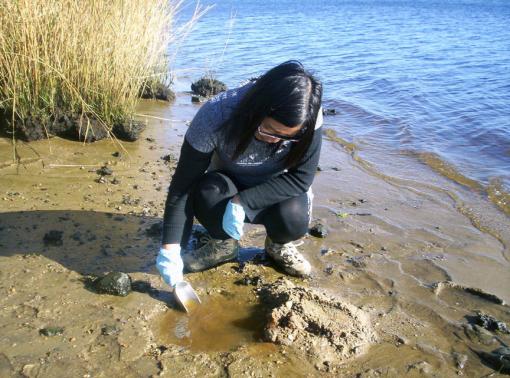
Postdoctoral Researcher Pengpeng Grimshaw takes samples
from a Rhode Island riverbank to assess possible contaminant
levels and study novel cleanup processes that have been
developed in a Superfund lab at Brown.
The Brown Superfund Program has created innovative ways to connect with local communities and develop the next generation of environmental leaders. The centerpiece of this effort is the Community Environmental College, an eight-week summer leadership program for inner-city youth. Last year, nearly 50 urban high-school students, primarily in Providence and Pawtucket, engaged in various activities to raise community awareness of the environment, ranging from enlisting Latino restaurants to supply used vegetable oil for biodiesel fuel, recycling mattresses, and encouraging convenience stores to stock healthier food. Brown students work with youth and community groups on myriad projects, including a year-round after-school program called ECO Youth, weatherizing homes and the “Hospitals for a Healthy Environment in Rhode Island” programs, which promotes cost-effective, healthy, and sustainable health-care institutions.

“Through our Community Engagement Core, we help local groups clean up contaminated land and work with legislators and regulators to strengthen state policies on brownfields, school siting, and various environmental justice issues,” said Phil Brown, professor of sociology at Brown and a researcher with the Superfund Research Program. “I am excited about our engagement with so many high school students in the Community Environmental College, as they learn so much and apply themselves to the Healthy Corner Store Initiative, weatherization, green transportation, and other critical concerns.”

The Brown Superfund Research Program is up for renewed funding in 2014. The renewal comes amid a competitive landscape; a decade ago, the federal Superfund Research Program supported 21 such programs nationwide.

“Continued funding will allow us to improve the prediction of the health risks associated with complex chemical exposures and devise new remediation strategies for contaminated sites,” Boekelheide said.

- by Richard Lewis

Wednesday, April 4, 2012

Brown’s Barrett Hazeltine Named one of America’s “Best 300 Professors” by The Princeton Review

Legendary engineering professor Barrett Hazeltine has been recognized by The Princeton Review as one America’s top undergraduate professors in its latest guidebook, The Best 300 Professors. The book profiles professors in 60 fields based on surveys by The Princeton Review and ratings on RateMyProfessors.com, the highest trafficked college professor ratings site in the country.

Data from RateMyProfessors.com identified more than 42,000 professors, and was culled down to a base list of 1,000 professors. After obtaining further input from university administrators and students, along with The Princeton Review’s surveys of the professors under consideration, the editors of The Princeton Review made the final choices of the professors.

Professor Hazeltine has taught engineering, management, and technology courses at Brown for more than 50 years, and currently teaches Management of Industrial and Non-Profit Organizations, Managerial Decision Making, and Appropriate Technology. He received awards for teaching from thirteen senior classes at Brown, 1972 to 1984, and 1990. In 1985, the award was named after him.

Simple method could aid in medical imaging, chemotherapy

Researchers, led by Robert Hurt, professor of engineering, have found that a simple technique can swathe nanoparticles with a blanket of graphene, which could carry medical imaging contrast agents, allowing the nanoparticles to enhance imaging signals while shielding tissue from their potential toxic effects. They could also deliver chemotherapy drugs to tumors.

Full report online: cen.acs.org/articles/90/web/2012/04/Graphene-Envelops-Nanoparticles.html

Full paper: http://pubs.acs.org/doi/full/10.1021/nl2045952

Wednesday, March 28, 2012

Andrew Peterson named Young Investigator

Andrew Peterson, assistant professor of engineering, has won a Young Investigator Award from the U.S. Navy. Peterson, one of only 26 young faculty nationwide to be selected, was recognized for scientific pursuits that show exceptional promise for the Navy and Marine Corps. The award is intended to promote the researcher’s professional development; Peterson will receive three years’ funding for research that could advance naval technology, the Navy announced Tuesday, March 27.

Peterson joined the Brown faculty in January. His primary research is devoted to figuring out how to produce carbon-based fuels from renewable sources. A key to such a breakthrough lies in overcoming the steep energy threshold needed to split carbon dioxide molecules into hydrocarbons. Peterson’s approach is to rely on quantum mechanics calculations to design catalysts to make those reactions more efficient and less costly.

Tuesday, March 27, 2012

Brown to host advanced materials conference

Brown University has organized a conference to explore the frontier of advanced materials. The all-day gathering on Thursday, March 29, 2012, features talks and discussions by leading innovators and scientists in industry, academia, and the federal government. The meeting stems from a call by President Obama for American companies to develop advanced materials at twice the speed as currently possible and at a fraction of the cost.

Cyrus Wadia“The federal government cannot by itself ensure that America remains the leader in this important sector.”Cyrus Wadia
“The federal government cannot by itself ensure that America remains the leader in this important sector.”
PROVIDENCE, R.I. [Brown University] — Last June, President Obama announced the Materials Genome Initiative, an ambitious effort to assist American companies to develop advanced materials at twice the speed as currently possible and at a fraction of the cost. The proposal stems in part from the startling losses in employment and technology that have beset the U.S. manufacturing sector and is intended to reposition America as a leader in producing advanced materials from safer, lighter vehicles to solar cells as cheap as paint. In a new funding request for next fiscal year, Obama seeks more than $100 million to continue the initiative.

Hoping to capitalize on the momentum, Brown University has organized a conference on March 29, 2012, to explore synergies and research opportunities in advanced materials. The all-day gathering features talks and discussions by leading innovators and scientists in industry, academia, and the federal government.
The meeting takes place on the Brown campus at the Salomon Center for Teaching, on the College Green. An agenda, list of speakers and other information is available online.
Cyrus Wadia, assistant director for clean energy and materials research and development in the White House Office of Science and Technology Policy, will give the plenary address. He will talk about how advanced materials are essential to economic security and human well-being.
“The Materials Genome Initiative will speed the discovery and development of many of those materials, and I will explain why the federal government cannot by itself ensure that America remains the leader in this important sector and why success will depend on a wide range of stakeholders and efforts, including regional efforts like those at Brown University,” Wadia said.
Other speakers and panelists will explore:
  • new materials for automobiles, aerospace, energy conversion/storage, microelectronics and medical devices;
  • emergent computational and experimental approaches;
  • strategies for sharing, storing, and searching materials data;
  • best practices for industry/university/government collaborations.
“Brown’s hosting of this meeting highlights the important role that the University can play in building strong research initiatives in this area,” said Clyde Briant, vice president for research. “The focus on the Materials Genome Initiative is an area where Brown already has great research strengths and one that should help us build partnerships with many other industries and universities.”
“Brown engineering’s unique interdisciplinary culture is ideally suited for producing new breakthroughs in advanced materials,” said Lawrence Larson, dean of engineering. “These breakthroughs often occur at the boundaries between traditional disciplines, like materials science, mechanical engineering, or electrical engineering. We look forward to developing exciting new collaboration opportunities that will result from this conference.”
The Materials Genome Initiative is connected to a larger call announced by Obama last summer to enlist industry, universities, and the federal government to invest in emerging technologies that will create manufacturing jobs and enhance U.S. competitiveness. Earlier this month, the president also asked for $1 billion to create a National Network for Manufacturing Innovation, to fund up to 15 regional hubs of manufacturing excellence.
“I’m calling for all of us to come together — private sector industry, universities, and the government — to spark a renaissance in American manufacturing and help our manufacturers develop the cutting-edge tools they need to compete with anyone in the world,” Obama said in a speech last summer. “With these key investments, we can ensure that the United States remains a nation that invents it here and manufactures it here and creates high-quality, good-paying jobs for American workers.”
The Materials Genome Initiative would direct funding to the Department of Energy, the Department of Defense, the National Science Foundation, and the National Institute of Standards and Technology. The initiative will fund computational tools, software, new methods for material characterization, and the development of open standards and databases that will make the process of discovery and development of advanced materials faster, less expensive, and more predictable.

Monday, March 26, 2012

President-Elect Paxson Visits School of Engineering

On Tuesday, March 20, Dean Larry Larson had the pleasure of leading President-Elect Christina Paxson on a tour of Barus and Holley, Prince Lab, and the Giancarlo Labs. This was the President-Elect’s first extended visit to campus since her selection as the University’s 19th President on March 2. During the visit, Paxson also met with senior administrators and faculty members and toured the libraries.

During her tour of the School of Engineering, President-Elect Paxson had the opportunity to meet many professors, graduate and undergraduate students, and staff, and see demonstrations of some of the research that is being conducted at the School.

Outstanding faculty members Arto Nurmikko, Gabriel Taubin, Ben Kimia, Rashid Zia, Chris Bull, Kenny Breuer, and Nitin Padture explained some of their ongoing research projects to the President-Elect.

She also had the opportunity to sit in on Professor Allan Bower’s freshman EN0040 class, where she was able to see student presentations.

“Having the opportunity to present our project to President-Elect Paxson was wonderful, not only because she had a very friendly and amiable demeanor, but also because she showed evident appreciation for our ideas,” said Emily Toomey ’15.

“Although the project at first seems like it has a simple objective, it required a great deal of collaboration, creativity, and application of engineering principles to create a successful result. By asking questions about our thought processes and how the MATLAB functions worked, President-Elect Paxson displayed a genuine interest in our efforts that made the project even more worthwhile,” added Toomey.

“What I enjoyed most about President-Elect Paxson's visit was the genuine interest that she showed in understanding our project,” said Maggie Coats-Thomas ’15. “The questions that she asked made it clear that she understood what was going on and appreciated our efforts, which I thought was very rewarding. She was very friendly and I am so pleased I got the opportunity to interact with her so soon after she was elected.”

The tour also provided the new President-Elect with the opportunity to see some of the space and facility constraints and challenges that currently exist in Barus & Holley. In an interview with the Brown Daily Herald, Paxson said of engineering, “it is clear that they’ve had a lot of growth, but they’re very tight on space.”

Overall, the tour was a great success in showcasing both the exciting work that is happening in the School of Engineering, and the need for expansion and growth.

‘Bed-of-nails’ breast implant deters cancer cells

Researchers at Brown University have created an implant that appears to deter breast cancer cell regrowth. Made from a common federally approved polymer, the implant is the first to be modified at the nanoscale in a way that causes a reduction in the blood-vessel architecture that breast cancer tumors depend upon, while also attracting healthy breast cells. Results are published in Nanotechnology.

PROVIDENCE, R.I. [Brown University] — One in eight women in the United States will develop breast cancer. Of those, many will undergo surgery to remove the tumor and will require some kind of breast reconstruction afterward, often involving implants. Cancer is an elusive target, though, and malignant cells return for as many as one-fifth of women originally diagnosed, according to the American Cancer Society.

A selectively inhospitable surface
A bumpy “bed of nails” surface does not allow cancerous
cells to gather the nutrients they need to thrive — possibly
because cancerous cells are stiffer and less flexible than
normal cells, which can manage the bumps and thrive.

Credit: Webster Lab/Brown University
Would it be possible to engineer implant materials that might drive down that rate of relapse? Brown University biomedical scientists report some promising advances. The team has created an implant with a “bed-of-nails” surface at the nanoscale (dimensions one-billionth of a meter, or 1/50,000th the width of a human hair) that deters cancer cells from dwelling and thriving. Made out of a common federally approved polymer, the implant is the first of its kind, based on a review of the literature, with modifications at the nanoscale that cause a reduction in the blood-vessel architecture on which breast cancer tumors depend — while also attracting healthy breast cells.

“We’ve created an (implant) surface with features that can at least decrease (cancerous) cell functions without having to use chemotherapeutics, radiation, or other processes to kill cancer cells,” said Thomas Webster, associate professor of engineering and the corresponding author on the paper in Nanotechnology. “It’s a surface that’s hospitable to healthy breast cells and less so for cancerous breast cells.”

Webster and his lab have been modifying various implant surfaces to promote the regeneration of bone, cartilage, skin, and other cells. In this work, he and Lijuan Zhang, a fourth-year graduate student in chemistry, sought to reshape an implant that could be used in breast reconstruction surgery that would not only attract healthy cells but also repel any lingering breast-cancer cells. The duo created a cast on a glass plate using 23-nanometer-diameter polystyrene beads and polylactic-co-glycolic acid (PLGA), a biodegradable polymer approved by the FDA and used widely in clinical settings, such as stitches. The result: An implant whose surface was covered with adjoining, 23-nanometer-high pimples. The pair also created PLGA implant surfaces with 300-nanometer and 400-nanometer peaks for comparison.

In lab tests after one day, the 23-nanometer-peak surfaces showed a 15-percent decrease in the production of a protein (VEGF) upon which endothelial breast-cancer cells depend, compared to an implant surface with no surface modification. The 23-nanometer surface showed greater reduction in VEGF concentration when compared to the 300-nanometer and 400-nanometer-modified implants as well.

It’s unclear why the 23-nanoneter surface appears to work best at deterring breast-cancer cells. Webster thinks it may have to do something with the stiffness of malignant breast cells. When they come into contact with the bumpy surface, they are unable to fully wrap themselves around the rounded contours, depriving them of the ability to ingest the life-sustaining nutrients that permeate the surface.

“This is like a bed-of-nails surface to them,” Webster said.

“I would guess that surface peaks less than 23 nanometers would be even better,” Webster added, although polystyrene beads with such dimensions don’t yet exist. “The more you can push up that cancerous cell, the more you keep it from interacting with the surface.”

The pair also found that the 23-nanometer semispherical surface yielded 15 percent more healthy endothelial breast cells compared to normal surface after one day of lab tests.

Webster and Zhang next plan to investigate why the nanomodified surfaces deter malignant breast cells, to create surface features that yield greater results, and to determine whether other materials can be used.

The National Institutes of Health’s National Center for Research Resources and the Hermann Foundation funded the research. Michael Platek at the University of Rhode Island helped with the electron spectroscopy for chemical analysis.

- by Richard Lewis

Engineering Graduate Student Fatih Calakli Wins Advanced Surface Reconstruction PCL Robotics Code Sprint 2012

Brown University School of Engineering graduate student Fatih Calakli has won the Advanced Surface Reconstruction PCL Robotics Code Sprint 2012, sponsored by Sandia National Labs.

Fatih is a student of Professor Gabriel Taubin whose group has made extremely important contributions to surface reconstruction, 3D compression, and object recognition.

The goal of this project is to make our state-of-the-art surface reconstruction algorithms widely available as part of the Point Cloud Library (PCL).

The Point Cloud Library is a stand alone, large scale, open project for 3D point cloud processing which is getting widespread support and attention from industry and academia. For more information, please go to: http://pointclouds.org/

Friday, March 23, 2012

Brown Graduate Student Lucy Weng ScB'08 Wins Award at the Northeast Bioengineering Conference

Brown University biomedical engineering graduate student Lucy Weng ScB'08 recently won the Master's Student Competition at the 2012 Northeast Bioengineering Conference hosted by Temple University in Philadelphia. Overall, there were more than 200 papers accepted, and awards were given for best paper to two master's student and two Ph.D. students. Weng received a certificate and a $250 prize.

Her paper, “Nanophase Magnesium for Orthopedic Applications” discusses the use of magnesium as a biomaterial for orthopedic applications because of its biocompatibility, biodegradability, and positive effect on bone formation. Likewise, studies have shown nanophase material increase osteoblast (bone-forming cell) function compared to conventional materials, but the two have not been studied together. The purpose of this study was to determine if altering magnesium surface features into the nanometer scale promotes greater osteoblast functions.

Nanorough magnesium surfaces were created by a novel treatment with sodium hydroxide at 1N, 5N, and 10N concentrations for 10, 20, and 30 minutes. Material characterization by scanning electron microscopy showed increased roughness on all treated samples compared to the control magnesium. Contact angle measurements indicated greater hydrophilicity on treated magnesium and no significant effect of ultraviolet sterilization on the surface energy of the material. Osteoblasts were seeded onto treated and untreated surfaces and adhesion at 4hrs were assessed through the MTT assay.

Results indicated increased osteoblast adhesion on nano-treated samples compared to untreated samples. These findings support previous studies indicating the promise of magnesium as a biomaterial for orthopedic applications and suggest further experiments examining the long-term effects of nanophase magnesium on osteoblast proliferation and function.

Building a better battery via technology crowdsourcing

Brown is one of the first participants to join Allied MindStorm, an open innovation website that invites the public (thinkers) to brainstorm new commercial applications around exciting technologies (challenges) developed by university researchers. In its initial submission on a Paper-Thin Plastic Battery Mashup, the public is invited to participate in postulating on new uses of the technology in the open innovation setting.

The new battery device submitted uses plastic, not metal, to conduct electrical current. It combines the power of a capacitor with the storage capacity of a battery. Tayhas Palmore, professor of engineering, worked with a team to develop the new type of battery that is a hybrid. It can store and deliver charge over long periods of time with greater power and with twice the storage of a double-layer capacitor.

Its power and paper-thin dimensions could be used for wrapping electronic devices but also be made into a fabric-like material. A description of the prototype is published in Advanced Materials: 18, 1764–1768.

Allied Mindstorm has a new website where university researchers can submit new technologies and then invites the public to come up with new applications for these technologies.

One of the first participants to join Allied MindStorm, Katherine Gordon, managing director of Brown University's Technology Ventures Office, said, "The decision regarding which application to pursue first is a complex and important one. Allied Minds is creating an entirely new way for universities to make this decision, while showcasing their most interesting research, but also improving them through open collaboration."


- Courtesy of the Technology Ventures Office

Three Biomedical Engineering Graduate Students Win Award

Brown biomedical engineering graduate students Gozde Durmus, Kim Kummer '11, and Erik Taylor were one of ten graduate student teams to win the Prize for Primary Healthcare Award (Phase I) from the Center for Integration of Medicine and Innovative Technology (CIMIT). The title of their project is "Using Nano-material Science to Inhibit Medical Device Infections".

Each winning team received $10,000, and they will now be able to use these funds to develop a final proposal over the next few months as they compete for the top three spots and a total of $300,000 in additional funds against teams from other top schools such as MIT, Johns Hopkins, and Yale.

“This is an outstanding achievement,” said Associate Professor Thomas Webster, “and places Brown among the top biomedical programs in the country.” Webster serves as the advisor to the three students on the research.

The award is for innovative technology ideas to improve the quality and efficiency of primary care in medicine. The Brown team was selected out of 76 applicants from 38 of the top engineering programs in the country. The goal of the competition is to stimulate the development of innovative technology to serve the needs of the frontlines of healthcare.

Thursday, March 22, 2012

Johnson & Johnson Corporate Office of Science & Technology Grant to Seed Biomedical Research

Brown announced that it has received an unrestricted grant from the Johnson & Johnson Corporate Office of Science & Technology (COSAT) to extend its seed funding for scientific research projects that have the potential to benefit patients and the healthcare system. Working with COSAT, Brown will identify projects, such as potential therapies, devices, or diagnostics, and then Brown will match funds from the grant to support the research.

“We're tremendously excited about launching this new translational seed fund,” said Katherine Gordon, who directs the university’s technology ventures office. “The funding dedicated to the new initiative will support grants for promising programs that require funding for proof of concept, feasibility or translational studies. We're very appreciative of this funding." 

Brown will retain all intellectual property rights to the research.

Friday, March 16, 2012

Assistant Professor Petia Vlahovska Wins Salomon Award

Assistant Professor of Engineering Petia Vlahovska was one of 15 faculty researchers who were honored on March 14 with a Salomon Award. The competitive grants come courtesy of the Richard B. Salomon Faculty Research Awards administered by the Office of the Vice President for Research (OVPR).

Clyde Briant, vice president for research, said the awards are primarily to stimulate new research projects by faculty. “We know oftentimes it’s hard to get (federal) funding” to begin major research projects, Briant said. “These funds are in place to help you do that.”

“We are the entity in modern society that’s charged with discovery,” said Provost Mark Schlissel, congratulating the award recipients. “This is what we thrive on, this is what we’re here for.” Schlissel, like Briant, noted that these awards are important for jump-starting complex research projects by getting preliminary data. “These awards help get research projects off the ground and get them competitive for further funding,” Schlissel said.

The Salomon Awards were established to support excellence in scholarly work by providing funding for selected faculty research projects of exceptional merit. Recipients receive as much as $15,000. The Salomon Awards have been administered by OVPR since 2003, and a total of about $2 million has been awarded to 132 faculty.

Vlahovska won a $15,000 award for her proposal, “Tension regulated phase separation in biomimetic multicomponent membranes.” Cells and cellular organelles are encapsulated by membranes composed of hundreds of lipids. This lipid diversity is essential for cell functions such as signaling: lipid mixtures organize into rafts, which serve as platforms for molecular-binding events at the membrane interface. Raft dynamics is regulated by physio-chemical variables like composition, temperature, and tension.

Vlahovska’s proposed research centers on the effects of tension on raft evolution and stability, which is virtually unexplored due to difficulties in tension control and quantification. Vlahovska proposes the use of electric fields and microfluidic flows to create well-defined tension conditions that will allow her to experimentally investigate lipid demixing and domain evolution in tense membranes. This knowledge will benefit bioengineering applications that exploit cell signaling machinery, such as targeted drug delivery.

Tuesday, March 6, 2012

Brown Professor Huajian Gao Receives Humboldt Research Award

Huajian Gao, Walter H. Annenberg Professor of Engineering at Brown University, has received a Humboldt Research Award from the Alexander von Humboldt Foundation in Germany. Award winners are invited to spend a period of up to one year cooperating on a long-term research project with specialist colleagues at a research institution in Germany. Professor Dr. Joachim P. Spatz nominated Professor Gao and is hosting him during his research in the Department of Biophysical Chemistry at the University of Heidelberg.

The award is granted in recognition of a researcher's entire achievements to date to academics whose fundamental discoveries, new theories, or insights have had a significant impact on their own discipline and who are expected to continue producing cutting-edge achievements in the future.

“This is a great award for Professor Gao,” said Dean Larry Larson. “He is one of the leading researchers and professors in his field, and that continues to be recognized on both a national and international level. We are fortunate to have him at Brown.”

Professor Gao received his B.S. degree from Xian Jiaotong University of China in 1982, and his M.S. and Ph.D. degrees in engineering science from Harvard University in 1984 and 1988, respectively. He served on the faculty of Stanford University between 1988 and 2002, where he was promoted to associate professor with tenure in 1994 and to full professor in 2000. He was appointed as Director and Professor at the Max Planck Institute for Metals Research in Stuttgart, Germany between 2001 and 2006. He joined Brown University in 2006. Professor Gao has a background in applied mechanics and engineering science. He has more than 25 years of research experience and more than 300 publications to his credit. In February of 2012, he was elected to the National Academy of Engineering (NAE).

Professor Gao’s research group is generally interested in understanding the basic principles that control mechanical properties and behaviors of both engineering and biological systems. His current research includes studies of how metallic and semiconductor materials behave in thin film and nanocrystalline forms, and how biological materials such as bones, geckos, and cells achieve their mechanical robustness through structural hierarchy.